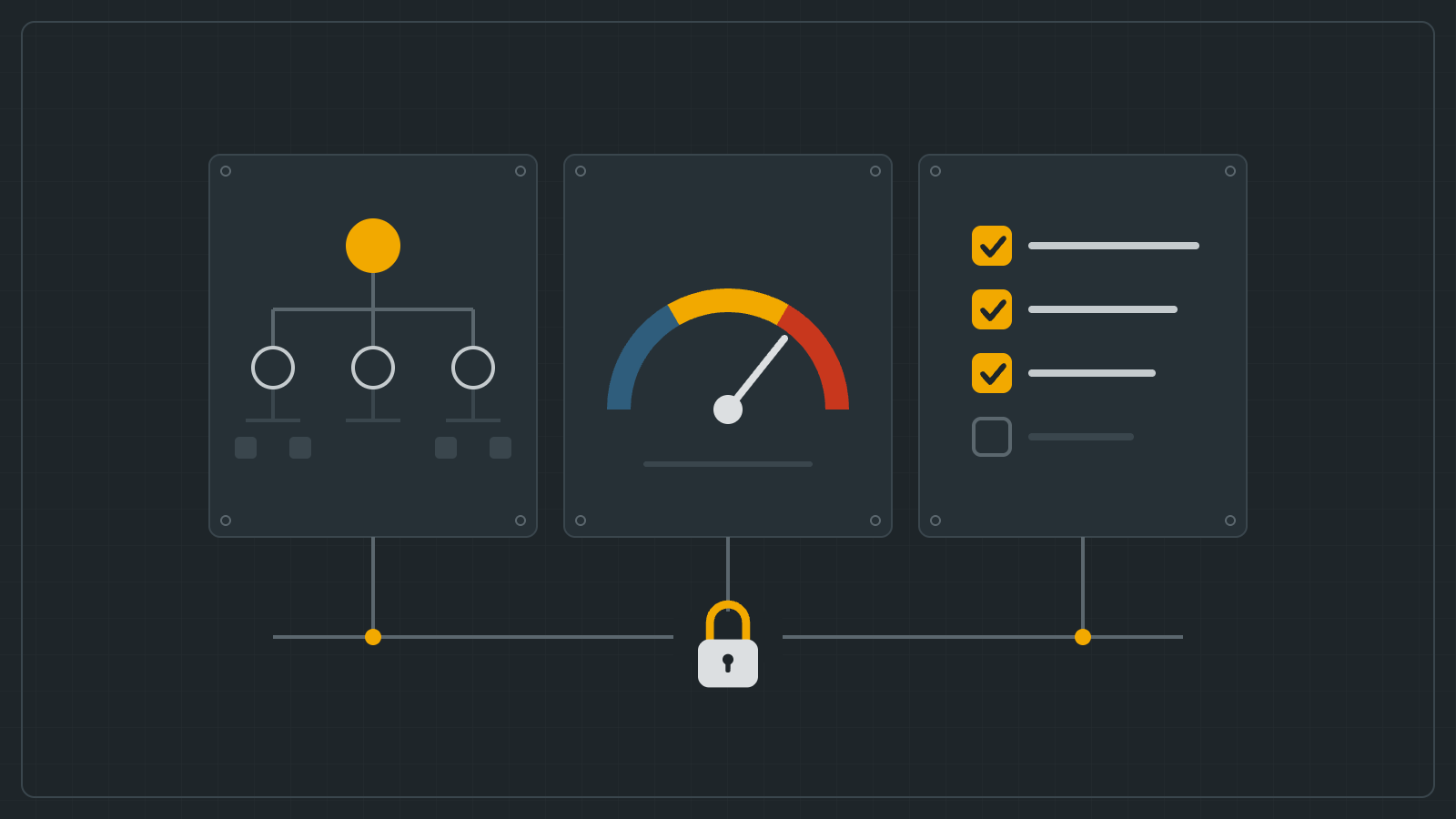
Most organisations are not short of security technology. Firewalls, endpoint protection and managed monitoring are widely deployed. What many lack is clarity on more fundamental questions: who owns cyber risk, how much of it the organisation is prepared to accept, and how it can demonstrate that its controls operate as intended. Governance, risk and compliance (GRC) is the discipline that answers those questions.
Three disciplines, one objective
Governance establishes direction and accountability. It defines ownership of cybersecurity, the policies that apply, escalation routes and how the board is kept informed. Without it, security becomes a sequence of reactive projects rather than a managed program.
Risk management determines where effort is directed. Assets differ in criticality and threats differ in likelihood. A structured risk process ranks exposures so that limited budget and resources are allocated to the scenarios with the greatest potential business impact.
Compliance demonstrates that the organisation meets its obligations under law, regulation, contract and recognised standards such as ISO/IEC 27001, the NIST Cybersecurity Framework and IEC 62443. It converts policy intent into verifiable evidence for auditors, regulators and customers.
Each discipline is limited in isolation. Governance without risk management produces policies that cannot be prioritised. Risk management without compliance produces analysis that cannot be verified. Compliance without governance produces documentation with no accountable owner. Combined, they form a continuous cycle: leadership defines risk appetite, risk analysis translates that appetite into priorities, controls are implemented, and compliance evidence reports back to leadership.
Why GRC has become a business necessity
GRC was once associated mainly with financial services. It now extends to almost every sector, for several reasons.
- Regulatory expectations have increased. Many jurisdictions now publish national cybersecurity controls, and critical infrastructure operators in particular are required to demonstrate conformance.
- Customers expect assurance. Security questionnaires and contractual security clauses are now standard in procurement. A maintained control register allows them to be answered quickly and consistently.
- Boards are accountable. Directors are increasingly expected to oversee cyber risk with the same rigour as financial and safety risk.
- Insurers require evidence. Cyber insurers assess governance, asset management, backup and incident response capability before offering cover.
- Environments are interconnected. Cloud services, remote access and connected industrial systems have eroded the traditional perimeter. Decisions on connectivity require defined ownership and an auditable record.
Characteristics of an effective GRC program
An effective GRC program is not defined by the volume of its documentation. It rests on a small number of maintained records that are used in day-to-day decision making:
- an inventory of critical assets with assigned owners
- a risk register recording likelihood, consequence and an accountable owner for each risk
- a control library mapped to applicable frameworks, with implementation status and evidence
- a remediation plan with target dates and visibility of slippage
- an incident log that feeds lessons learned back into the risk register
When these records are linked, a question such as “what is our exposure if this remote access gateway is compromised?” can be answered by tracing from the asset, through its risks and controls, to the remediation actions already in progress.
Getting started
Begin with a defined, manageable scope. Select one site or business service, identify its critical assets, record the risks of greatest concern and map existing controls against a single framework. The first iteration will not be complete, and it does not need to be. It gives leadership a concrete basis for discussion and directs subsequent security investment to where it delivers the greatest risk reduction.
GRC is what transforms cybersecurity from a cost that is difficult to justify into a business discipline that can be planned, measured and defended.